People with a legal problem search for answers long before they pick a solicitor. The firm that answers their question clearly earns the trust, the ranking and the call. We help Irish law firms become that firm, with content that demonstrates real expertise and stays inside the LSRA advertising rules.
A silent website loses the client before you ever hear from them
The path to a new instruction now starts with a search. Someone in Dublin, Cork or anywhere in Ireland has a legal worry, and the first thing they do is type a question into Google: how long does conveyancing take, do I need a solicitor to make a will, what happens after a workplace accident. They read, they form a view, and they trust the firm that gave them a clear answer.
If your website is little more than a list of services, you are invisible at that moment. The competitor who answered the question well is the one who earns the trust and the enquiry, often before your firm is even considered. Good content is how you get into that conversation early and stay in it.
Content marketing turns your knowledge into a steady source of clients. Done well, it draws in people who are actively researching the work you do, builds trust before the first call, and keeps earning enquiries month after month at a lower cost than ads alone.
What this looks like when it is not working
A website that lists services but answers none of the questions clients ask
Competitors ranking for the searches that lead to instructions
Thin practice area pages that read like every other firm
A blog that is empty, dated or talks about the firm rather than the client
No content built for the way clients now search through AI and assistants
Worry that publishing more could breach the LSRA rules
Your guide
Legal content learned in the toughest market in the world, applied to Irish firms
SolicitorDigital.ie is led by Casey Meraz, a well known US legal marketer and the founder of Juris Digital, one of the most recognised legal marketing firms in the United States. For over 15 years he and his team have produced the kind of legal content that wins clients in the most competitive legal search market there is.
Now based in Kinsale, Co. Cork, Casey brings that same playbook to Irish solicitors, through SolicitorDigital.ie, operated by Ethical Digital Marketing Limited. You get big market content expertise applied to your firm, here in Ireland, where the competition is still catching up, and you get someone who understands the LSRA rules your content has to work within.
Why firms trust us with content
Founded by Casey Meraz, a recognised US legal marketing leader
15+ years producing legal content, US and Ireland
Fluent in LSRA advertising rules and GDPR
Content, SEO, Google Ads and websites under one roof
Reporting in plain numbers: rankings, enquiries, cost per client
No long term lock in, we earn the next month with results
What we do
What content marketing for solicitors actually involves
Good legal content is not just a blog. It is a planned set of pages working together to answer real questions, demonstrate expertise and turn readers into enquiries. Here is the work that gets Irish firms found and trusted, and what each part does for you.
Practice area pages
These are the money pages. We write dedicated, in depth pages for each practice area you want clients for, from personal injury and conveyancing to family law, employment and probate. Done properly they outrank the thin, generic pages most firms publish and they explain the work in a way clients understand.
Legal guides and FAQs
The questions Irish clients actually search, answered in plain English: how long conveyancing takes, whether you need a solicitor to make a will, how much probate costs. Clear guides and FAQ pages build trust at the research stage and capture the long tail of questions that lead to instructions.
Blog posts and articles
A focused stream of articles on the topics, cases and changes in the law that matter to your clients. Not news for its own sake, but useful, timely pieces that bring people in, support your practice area pages and give your firm a reason to stay visible between bigger projects.
Pillar and cluster content
We build deep pillar guides on your core topics and link them to supporting articles around each one. This cluster structure is how a firm becomes the recognised source on a subject in Google's eyes, building the topical authority that lifts every related page.
EEAT and YMYL for legal
Google holds legal content to a higher bar because it affects people's rights, money and wellbeing, a category it treats as your money or your life. We write or review content under a named solicitor and demonstrate genuine experience, expertise, authority and trust, so your pages earn rankings that anonymous content cannot.
Topical authority
Covering a topic completely, not just one keyword, is how firms win in legal search now. We map the full set of questions and subtopics around each practice area and build them out so your site becomes the most thorough, trusted resource on the subjects you want to be known for.
Keyword and question research
We research the terms and questions real clients use, the long tail as well as the obvious ones, and combine practice area and city searches like family law solicitor Galway with the People Also Ask questions around them. The content plan is built on what people search, not guesswork.
Content that earns links
Original guides, useful data and clear commentary give Irish legal directories, the Law Society and the press a genuine reason to cite you. Earned links of this kind build the authority that lifts your rankings, and they come from being a real source rather than chasing spam.
Conversion copy
Traffic alone pays no bills. We write content with a clear next step built in: a click to call, an enquiry form, a reassuring call to action at the right moment. The aim is content that turns readers into the people who actually pick up the phone or fill in the form.
Answer engine readiness
A growing number of people get answers from AI search like ChatGPT and Google AI Overviews before they ever click, though it is still early for legal searches in Ireland. We structure content so it is clear, citable and easy for these systems to quote, with direct answers, clean formatting and schema, so your firm shows up where research increasingly begins.
Internal linking
Good content does not sit on an island. We link guides and articles into your practice area and location pages with helpful, varied anchors, so readers find their next step and Google understands how your site fits together and which pages matter most.
Content audit and refresh
Law changes and content dates. We audit what you already have, update pages that have slipped or gone out of date, keep them accurate, and repurpose strong pieces across email and social so each one earns its keep for longer.
Where you show up
Where good content gets you found
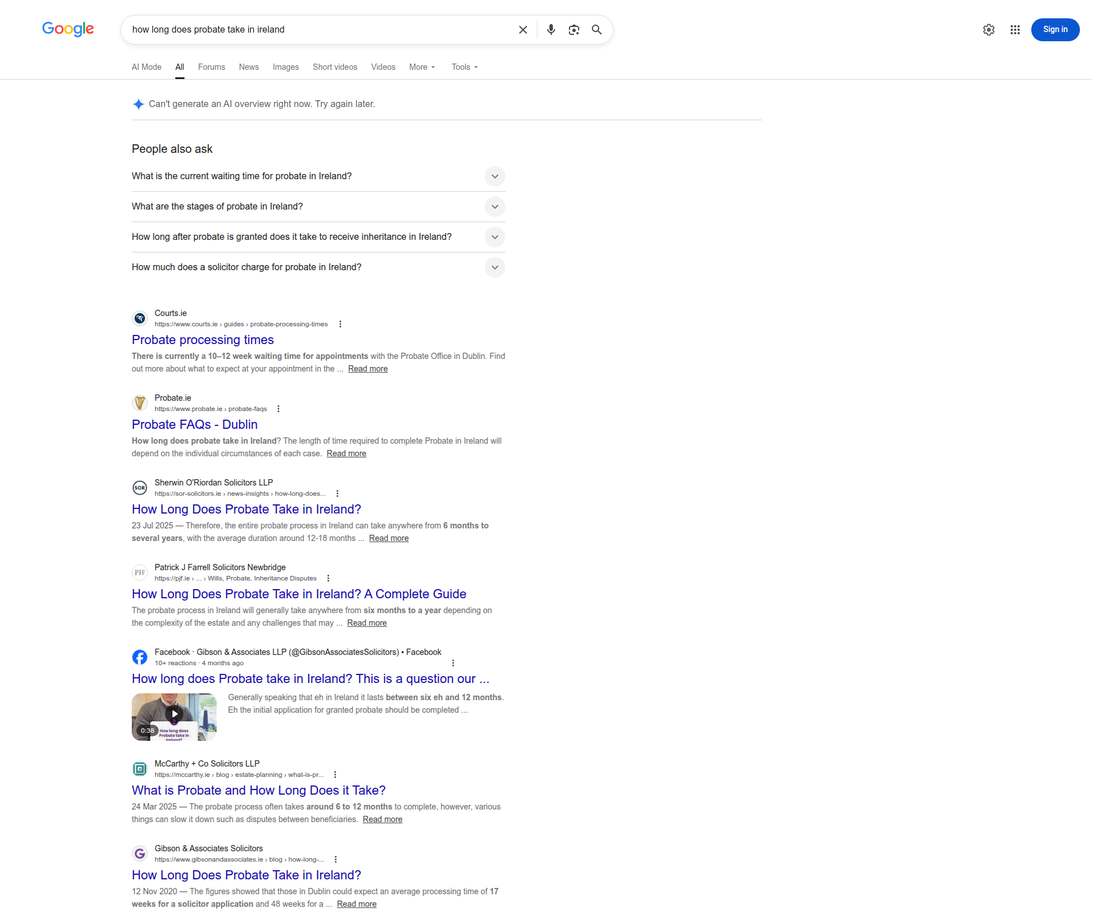
When someone searches a real question, like how long probate takes, Google rewards the firms that answer it clearly. Here is where useful content shows up.
Example Google search in the Republic of Ireland, June 2026. Search: how long does probate take in Ireland.
People also ask. The related questions Google expands. Content that answers them clearly can earn a place here.
AI Overview. Google's AI answer, which pulls from trusted, well structured pages. Good content is how your firm gets cited.
Organic results. The firms ranking here are solicitors who wrote a genuinely useful answer. They earn the click, and the trust, before a single call. This is the same work behind SEO.
Featured snippets. The short answer Google lifts to the top for some questions. Precise, well formatted content wins it.
Video. Short explainer videos can appear in the results too.
What questions are you missing?
We will send you the client searches your site does not answer yet, and the pages to write.
No black box, no guesswork. You always know what we are writing and why, and we report against enquiries, not vanity metrics.
1
Free content plan
We research the questions your clients search, the content your competitors rank for and the gaps on your own site, then map the priority practice area and location pages, guides and FAQs that will earn the most enquiries. You get a clear roadmap whether you work with us or not.
2
Scope to your budget
We start from your goals and what a case is worth to you, then agree how much content to produce and in what order to hit them within what you can spend. You approve the scope and the topics before anything is written.
3
Write and publish, LSRA reviewed
We research, write and shape each page for search and conversion, draw on your expertise, attribute it to a named solicitor, and review every piece for LSRA compliance before it goes live. You approve before we publish.
4
Measure and refine
Every month you get a plain report showing rankings, organic traffic, the enquiries content is influencing and the work completed. We see what is landing, refresh what needs it, and keep building the topics that bring your cost per client down.
Why quality wins
Legal content is held to a higher bar, and that is your advantage
Legal topics fall into the category Google calls your money or your life, content that can affect a person's rights, finances and wellbeing. Google holds this content to its highest standard, leaning hard on experience, expertise, authority and trust, known together as EEAT. Thin, anonymous, copied pages do not rank for this work, and they should not.
That bar is good news for a real firm. You have the experience and the expertise that an agency churning generic content cannot fake. Our job is to surface it: content written or reviewed by a named solicitor, accurate and current Irish law, clear sourcing and a firm that is genuinely recognised for the topic. That is what earns lasting rankings and the trust that turns a reader into a client.
How we build EEAT into every page
Content written or reviewed by a named solicitor at your firm
Accurate, current Irish law, checked before publishing
Clear author and firm credentials that show real expertise
Genuine depth on a topic rather than thin, generic pages
Honest, non misleading explanations clients can rely on
Signals of authority through earned links and citations
Built for Irish firms
Content that stays inside the LSRA rules
Publishing content as a law firm in Ireland is not the same as marketing any other business. The Legal Services Regulatory Authority sets clear limits on how solicitors can advertise under the Legal Services Regulation Act 2015, with particular restrictions around personal injury work. Many of the guides ranking today are written for the UK and lean on rules that simply do not apply here.
We know the Irish rules, and we write every page, guide and FAQ to stay the right side of them: truthful, professional and never misleading about outcomes. We also handle GDPR and the Data Protection Act 2018 properly, with compliant forms and cookie consent and secure handling of the enquiries your content brings in.
Compliance areas we cover
LSRA advertising restrictions, including personal injury
Truthful, non misleading claims and outcome language
Proper disclaimers on solicitor content and pages
GDPR compliant contact forms and data handling
Cookie consent that meets Irish standards
Review and testimonial compliance in content
You focus on practising law. We handle the content and keep it compliant, end to end.
Who we help
Built for your practice area, right across Ireland
Every area of law has its own clients, questions and competition. We tailor the content strategy to the work you want, wherever in Ireland your firm is based.
Content marketing for solicitors, common questions
How long does content marketing take to work for a solicitor?▼
Content marketing is a long game that compounds. Pages built around real client questions can start drawing traffic within a few months, but the bigger gains in rankings and enquiries usually arrive over 6 to 12 months as your topical authority grows and links accrue. Unlike ads, the content keeps working long after it is published, so the cost per enquiry falls over time. We set honest expectations and report progress every month.
How much does content marketing cost for a law firm in Ireland?▼
We price each service individually rather than in fixed packages, and build the plan around your goals, your practice areas and your budget. You can see indicative figures on our pricing page. You get a clear quote after your free content plan, with no surprises.
Is legal content marketing compliant with LSRA advertising rules?▼
Yes, when it is done properly. We write every page, guide and FAQ to comply with the Legal Services Regulatory Authority rules under the Legal Services Regulation Act 2015, including the restrictions around personal injury work, and we keep claims truthful and never misleading. We also handle GDPR and the Data Protection Act 2018 correctly. Compliance is part of the writing process, not an afterthought.
Can AI just write our legal content for us?▼
AI can help with research and first drafts, but legal content is a category Google treats as your money or your life, where accuracy and trust matter most. Unchecked AI gets Irish law wrong, invents detail and reads like every other firm. We use AI as a tool, then ground every page in real expertise, name a solicitor as the author or reviewer, and check it against current Irish law before it goes live.
What is EEAT and why does it matter for legal content?▼
EEAT stands for experience, expertise, authority and trust. Google leans on these signals hardest for legal content because it affects people's rights, money and wellbeing. In practice it means content written or reviewed by a named solicitor, accurate and current Irish law, clear sourcing, and a firm that is genuinely recognised for the topic. Pages that show real EEAT earn rankings that thin, anonymous content never will.
What should a solicitor actually blog about?▼
The questions your clients type into Google before they call. Things like how long conveyancing takes in Ireland, whether you need a solicitor to make a will, how much probate costs, or what to do after a workplace accident. Answer those clearly and accurately and you build trust, rank for the searches that lead to instructions, and give clients a reason to choose you over the firm that stayed silent.
Do you write the content or do we?▼
We do the heavy lifting. We research the topics, write the pages and guides, and shape them for search and conversion. You stay the expert: we draw on your knowledge through short interviews or notes, attribute content to a named solicitor, and you approve everything before it is published. It is built to read like your firm, not a generic agency.
Do you only work with solicitors in Dublin?▼
No. We work with solicitors across the Republic of Ireland, from Dublin and Cork to Galway, Limerick, Waterford and every county, and we are based in Kinsale, Co. Cork ourselves. Firms outside the capital often see faster results because there is less competition for the practice area and location terms that matter.
Free content gap report
See the questions you are missing
Your clients ask Google questions every day. Tell us your practice areas and we will send you the exact searches your site does not answer yet, that your competitors do, with a priority list of pages to write. No obligation, no pressure.
What your report shows
The client questions you do not rank for yet
The pages your competitors have that you do not
The highest priority practice area and location pages to write